






If you’ve been reading about the Home Energy Model, you may have come across the term HEM wrappers and wondered what that actually means in practice. They are an integral part of how the whole system will function, so in this blog post we will take a closer look at how they actually work.
The Core
The core calculation is the main part of the Home Energy Model. It runs complex building simulations to determine:
- How heat moves around the building
- How much heating, cooling and hot water is needed and the resulting energy demand for mains gas and electricity etc
This is the building’s ‘physics engine’, it just runs the simulation. The core is designed to operate within a wrapper framework. Technically, it could be run on its own, however it requires a lot of very detailed information (such as hot water demand profiles) across the calculation period. This is not very practical for most policy uses. This is where the wrappers come in. The core relies on wrappers to provide structured inputs and apply policy rules.
The Wrappers
The wrappers sit around the core, providing a pre-processing and post-processing step.
Before the Core Calculation (Pre-Processing)
The wrappers adjust the required inputs. This means that a user doesn’t have to provide all of the detailed information than the core actually requires, because the wrapper will transform the input data set it receives into what is required by the core calculation. It doesn’t just invent these figures out of nowhere though, it fills in the missing data using policy rules.
After the Core Calculation (Post-Processing)
After the calculation has run, the wrapper will apply post-processing of outputs. This includes applying emissions and primary energy factors according to policy. Different policies may need different assumptions, so instead of changing the core engine every time, they each have different wrappers.
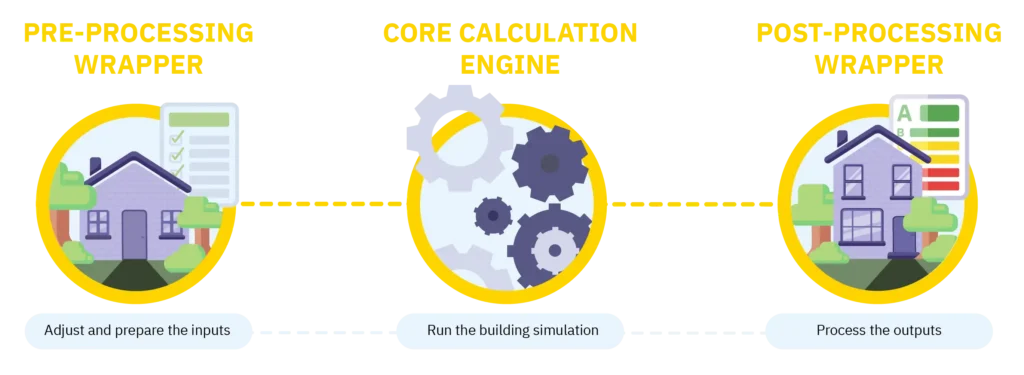
So, in practice, the domestic EPC wrapper could take the Domestic Energy Assessor’s on-site data, expand it into the detailed inputs the core model needs, run the simulation, and then apply the official carbon and primary energy factors to produce the EPC rating.
Why Not Just Use The Core Without The HEM Wrappers?
Simply put, it’s not practical. The core needs very detailed data. The wrapper takes simpler data and expands it into the detailed data the core needs. It makes assumptions based on policy to tailor the calculation to each field. It basically translates policy-level inputs into physics-level inputs.
In addition, this approach facilitates flexibility in the future. The core is about physics and energy modelling, whereas the wrappers are about policy rules and standardisation. That separation means the core doesn’t change every time policy changes. New wrappers can be created in the future for new regulations and existing wrappers can be updated without rewriting the modelling engine.