





The latest edition of the RdSAP 10 Conventions has been published, bringing a series of important clarifications and new assessment rules for domestic energy assessors.
Version 12.2 applies from 6 August 2026 and supersedes previous editions. Its revision history identifies 16 amended conventions, four newly added conventions and the deletion of Appendix 4. Although some amendments clarify existing practice, others will directly affect how assessors classify properties, collect evidence and enter information into RdSAP software.
If you’ve already read our article covering the earlier RdSAP 10 updates, this guide focuses only on the conventions amended on 13 July 2026.
While some amendments are small editorial corrections, several introduce important clarifications that could affect how assessments are completed in practice. Below, we explain the most significant RdSAP Updates and what they mean during an assessment.
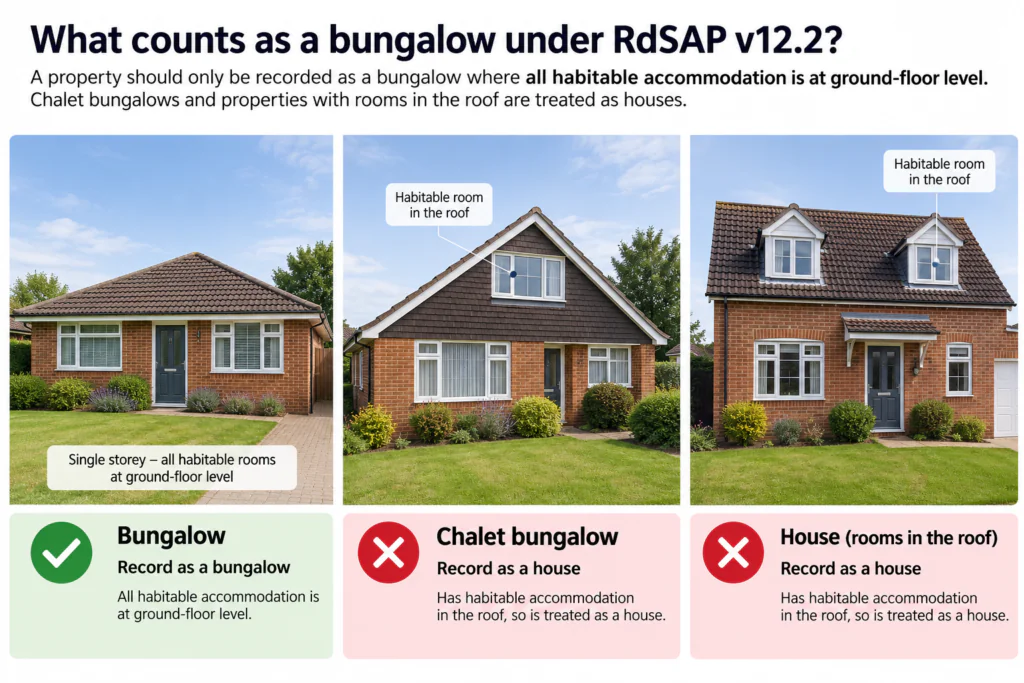
Clearer definitions for bungalows and self-contained annexes
The definition of a bungalow has been tightened. A property should only be recorded as a bungalow where all habitable accommodation is at ground-floor level. Chalet bungalows and properties with rooms in the roof are treated as houses.
There is also more detailed guidance for deciding whether an annexe or separate part of a building is a self-contained dwelling requiring its own EPC. Fixed cooking and bathing facilities are required, with the cooking provision expected to include a fixed oven, sink and either two fixed hot rings for a one-bedroom dwelling or four for a larger dwelling.
The separate unit must also have its own access, either from outside or through a communal corridor. The presence of an internal connecting door to the main property does not, by itself, prevent the unit from being treated as self-contained.
Significant changes to rooms in the roof
Convention 2.06 has received one of the most substantial updates in the RdSAP Conventions v12.2, with new guidance designed to improve consistency when assessing loft conversions and rooms in the roof.
Among the key changes are:
- New 25% rule for connected gable walls – Where only part of a gable wall is connected to another part of the dwelling, it is now treated as exposed if less than 25% of the wall is connected, and connected if more than 25% is connected.
- New 20% dormer rule – Small dormers occupying less than 20% of the room-in-roof floor area can be ignored when measuring the roof. Larger dormers must be measured separately, with their vertical faces recorded as stud walls and their roofs as flat ceilings.
- Improved treatment of hidden insulation – Where there is clear evidence that insulation continues from the rafters through to the eaves, an unobservable stud wall can now be assumed to have the same insulation level, avoiding unnecessary assumptions of an uninsulated element.
- Simplified treatment of complex roof geometry – Where multiple similar roof elements exist, assessors are now instructed to merge the areas together, simplifying data entry.
- Direct use of RdSAP 10 U-values – In certain room-in-roof constructions, assessors can now use the standard U-values from Table 18 of the RdSAP 10 Specification, reducing the need for individual element calculations.
These changes provide much clearer guidance for assessing loft conversions, improve consistency between assessors and simplify some of the more complex room-in-roof scenarios encountered during EPC surveys.
Alternative walls, secondary glazing and sun rooms
Convention 2.13 now states that areas of particularly poor thermal construction (such as single-leaf panels or uninsulated timber panels beneath windows) should be treated as curtain walling where they are large enough to be included in the assessment.
The secondary-glazing guidance has also been expanded. Non-standard improvements, such as removable plastic units fitted over single glazing or additional panes separated by an unusually large gap, should now be treated as secondary glazing.
Highly glazed building parts that do not meet the new conservatory definition should be treated as sun rooms, with all relevant windows and roof windows measured individually.
New rules for Heat-as-a-Service arrangements
A new Heat-as-a-Service convention has been introduced.
Where a service provider owns or operates the heat generator, the arrangement must be treated as community heating, regardless of whether the generator is located inside or outside the dwelling. Specific documentary evidence is required to confirm that a Heat-as-a-Service arrangement is present.
For data entry:
- an electrically powered service is entered as a community heat pump;
- other arrangements are entered as a community boiler.
This creates an important exception to the standard community-heating rule, under which a generator located within the dwelling would normally be treated as that dwelling’s own heating system.
Properties with two mechanical ventilation systems
New Convention 7.03e explains how to assess a dwelling containing two mechanical ventilation systems.
Where the systems are identical, the system is selected with half the total number of wet rooms attributed to it. Where the systems differ and only one is available in the PCDB, that system is used.
Where both systems are database products, or both are default systems, the convention establishes the following order of precedence:
- Mechanical ventilation with heat recovery
- Mechanical ventilation
- Mechanical extract ventilation
- Positive input ventilation from outside
- Positive input ventilation from the loft
This provides a consistent approach where the software can only accommodate one ventilation-system entry.
Conservatories: A Clearer Definition
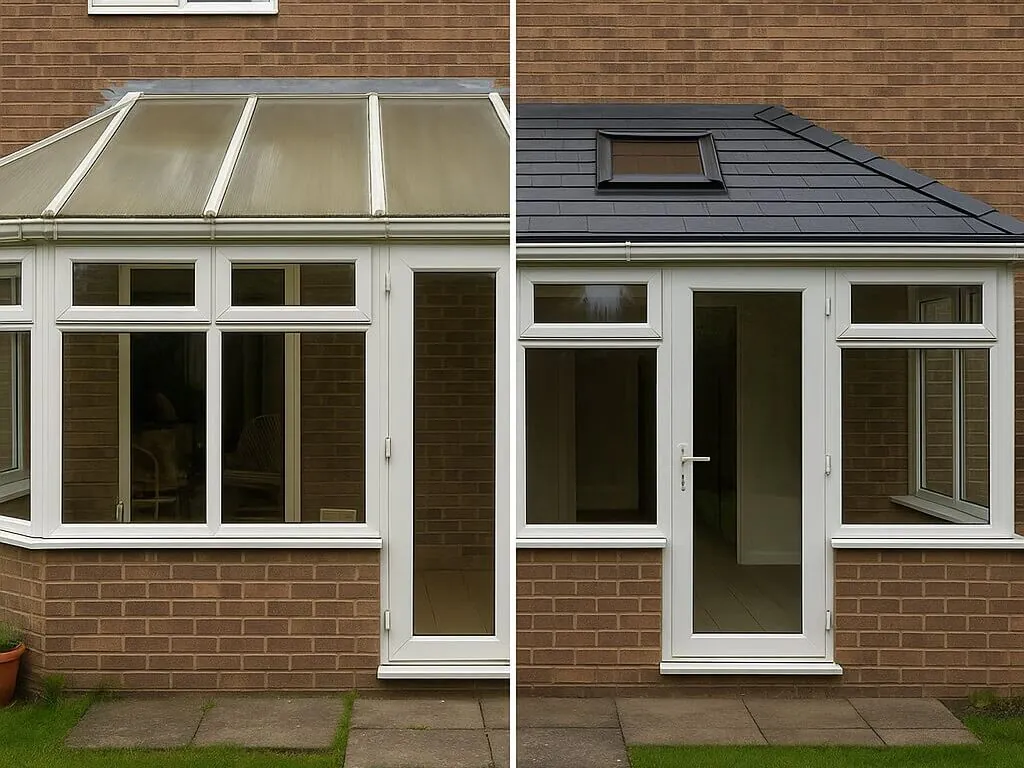
One of the most useful additions is the expansion of the definition of a conservatory under Convention 2.28. The convention states:
“For RdSAP purposes a conservatory can be defined as a building part where 50% or more of the
external heat loss walls are glazed and where 75% or more of the roof is glazed.
In circumstances where the roof of a conservatory no longer meets the above definition because the
roof has been replaced or a false ceiling has been added the conservatory must be recorded as an
extension specifying the below;
- If either visual or documentary evidence is available record insulation present.
- If the roof is less than 10 degrees in pitch enter as flat with insulation unknown.
- If the roof is more than 10 degrees in pitch enter as pitched, no access and insulation as none
- If the roof is more than 10 degrees in pitch and there is access to the loft void see convention
3.04.”
– Convention 2.28
The update tackles a common area of uncertainty: conservatories with replacement solid roofs. If the glazing percentages no longer meet the 50% glazed walls and 75% glazed roof definition, the building part should now be assessed as an extension instead of a conservatory. The convention now explains how the replacement roof should be recorded depending on the available evidence and construction type, including when documentary evidence is unavailable.
For DEAs, this should significantly reduce inconsistencies when assessing converted conservatories, an area that has historically relied heavily on assessor judgement.
Heating System Clarifications
Several of the July amendments focus on ensuring heating systems are recorded consistently.
Incomplete Heating or Hot Water Systems (Convention 4.03)
Convention 4.03 has been expanded beyond heating systems alone to also apply to hot water systems. It now says that:
“Any fixed heating or hot water source and/or heat emitters fitted/installed but not working (or condemned) it should still be taken into account when deciding on the primary and secondary heating Direct Hot Water Type“
– Convention 4.03
This is an important distinction. If a fixed hot water appliance has been installed but is not working, incomplete or inaccessible, it must still be considered when determining both the primary heating system and the direct hot water type. The amendment ensures assessors apply the same approach to hot water systems as they already do to space heating in this case.
Electric Combi Boilers (Convention 4.22)
Electric combi boilers have often caused uncertainty because they do not fit neatly into traditional boiler categories. The new convention removes that uncertainty by providing a prescribed method of entry. It states:
“Space heating provided by an electric combi boiler should be recorded manually as Standard boiler, direct acting, fuel type electricity.”
– Convention 4.22
The convention goes on to remind assessors to refer to convention 6.08 for water heating from an electric combi boiler. Convention 6.08 has remained the same as in previous versions of RdSAP.
Two Main Heating Systems (Convention 4.09)
Although the majority of Convention 4.09 remains unchanged, an additional clarification has been introduced for high heat retention storage heaters. Where a high heat retention storage heater cannot be found within the Product Characteristics Database (PCDB), the convention now instructs assessors to record it as a fan-assisted storage heater.
This provides a clear fallback position where previously there was no defined approach.
Chimneys: More Precise Guidance for Decommissioned Fireplaces
Convention 9.01 receives one of the most practical July updates. Historically, assessors have often encountered fireplaces that have been blocked, capped or partially decommissioned, with uncertainty over whether they should still contribute to ventilation losses. The definition of an open chimney still remains a vertical duct for combustion gases of diameter 200mm or more, or a rectangular duct of equivalent area (125,000 mm2), and assessors are to include all open chimneys/fireplaces in the count.
However, the revised convention now explains that decommissioned chimneys with air bricks installed must be considered in RdSAP. In cases where it has ventilation openings smaller than 30,000 mm² , it should be treated as a blocked chimney, while larger permanently ventilated openings continue to be treated as open chimneys. The convention guidance reads as follows:
“A chimney/fireplace can be decommissioned with the fireplace filled in and the chimney stack capped or removed completely. A chimney may require ventilation to manage moisture through the provision of air bricks, for example when it is on an external wall.
In some circumstances a chimney can be sealed completely (i.e. no air bricks are required) in which case it does not need to be counted as a chimney in an RdSAP assessment. However, where a decommissioned chimney has air bricks installed, this needs to be considered in RdSAP. Specifically, a decommissioned chimney that is provided with a ventilation area less than 30,000mm2 is treated as a blocked chimney, i.e. modelled with a flow rate of 20 m3/hr. If a chimney is open it is modelled with a flow rate of 80 m3/hr.
Other cases which should be treated as open chimneys:
- chimney attached to a decorative gas fire,
- chimney fitted with a damper, and,
- decommissioned chimney with a ventilation area greater than or equal to 30,000mm2″
– Convention 9.01
Documentary Evidence: Avoiding Assumptions
Documentary evidence remains one of the most important aspects of RdSAP. Convention 9.02 now provides clearer guidance for cases where you have documentary evidence of either intent to install insulation, or Building Control Oversight, but no evidence confirms insulation thickness. So, there is documentation of intent to upgrade and visual observation of insulation, but it can’t be physically measured and the documentation doesn’t state the thickness. Rather than selecting ‘as built’ or ‘unknown’, the updated convention now instructs assessors to record the insulation thickness as ‘insulated – insulation thickness unknown‘ where appropriate.
To illustrate, suppose you’re assessing a house. You face a single storey side extension built in 1950 which has undergone insulation upgrades to its roof and walls. There is documentation for the intent of this, and on inspection the customer has shown you roof insulation behind several light fittings in the ceiling, and wall insulation behind several wall sockets, but you can’t measure it. This is when it could then be recorded as ‘insulated – insulation thickness unknown’.
This is an important refinement because it prevents assessors from inadvertently overstating the thermal performance of an element simply because documentary evidence is incomplete, or disregarding the upgrade completely. Where reliable evidence cannot support a specific insulation depth, the conventions now favour recording uncertainty rather than making assumptions.
Photovoltaic Systems and Battery Storage
As battery storage becomes increasingly common alongside domestic solar PV installations, Convention 9.05 has been expanded to capture this information more consistently. The revised guidance states:
“Where an individual battery has a storage capacity greater then 5Kw. The PV battery shall be
entered as two separate batteries. The first PV battery entry shall be 5kW, with the excess being entered as a second battery.”
– Convention 9.05

These changes ensure battery storage is represented consistently within RdSAP software, regardless of manufacturer or system configuration.
Waste Water Heat Recovery
Waste Water Heat Recovery Systems (WWHRS) continue to receive additional guidance as installations become more widespread.
The July amendments further clarify how assessors should record the number of baths, showers and connected systems, while upholding that WWHRSs should only be included where the exact model can be found within the Product Characteristics Database (PCDB).
“For instantaneous and storage types and when no/unknown [Waste Water Heat Recovery System (WWHRS)] present:
- The total number of baths within the property.
- Total number of baths connected to WWHRS (if present).
- Type and number of non-electric showers.
- The shower must be permanent i.e. not temporarily attached to bath taps when in use.
- If shower connected to WWHRS – Instantaneous or Storage should be selected.”
– Convention 9.08
The additional detail should help improve consistency when surveying properties with more complex bathroom layouts or multiple shower installations.
Air Tightness Certificates Must Still Be Valid
Convention 10.01 includes a small but important clarification around pressure test certificates. It now states:
“If material changes have been made to the property since the original [air tightness] test, the certificate becomes invalid for RdSAP entry.”
– Convention 10.01
This means assessors should not rely on historic air pressure tests where significant alterations have taken place since testing, such as extensions, major refurbishment work or replacement building elements.
Although simple, this clarification reinforces that documentary evidence must remain relevant to the property in its current condition.
Appendix 4 has been removed
Appendix 4, which previously covered room-in-roof U-values, has been deleted. The updated roof-room convention instead allows relevant U-values to be inferred from Table 18 of the RdSAP 10 specification where the stated conditions are met.
What These July RdSAP Updates Mean for DEAs
The July 2026 RdSAP Changes are less about introducing new methodology and more about improving consistency across the industry. Many of the amendments remove areas where assessors previously had to rely on professional judgement, replacing them with clearer rules.
As domestic technologies continue to evolve, these refinements should help ensure EPCs are produced more consistently while reducing variation between assessors carrying out similar surveys. Now it is down to DEAs to be determined to closely follow these new conventions.
DEAs should take time to familiarise themselves with the RdSAP changes to stay compliant and confident in their reporting. Energy Trust will be providing guidance and resources throughout every DEA course we teach to ensure that our DEA learners are fully equipped to comply with these adjustments when they come into effect on August 6th 2026.
This article provides an overview of the principal changes. Assessors should refer to the complete v12.2 conventions and any additional guidance issued by their accreditation scheme when completing assessments.